Carter Dack, 2026.
Embedded chat services have long been a staple of interactive web experiences, offering site operators a seamless way to engage their audiences. What is often overlooked, however, is the degree to which third-party services extend a site's attack surface, and the extent to which their vulnerabilities can be weaponized against the very users they serve.
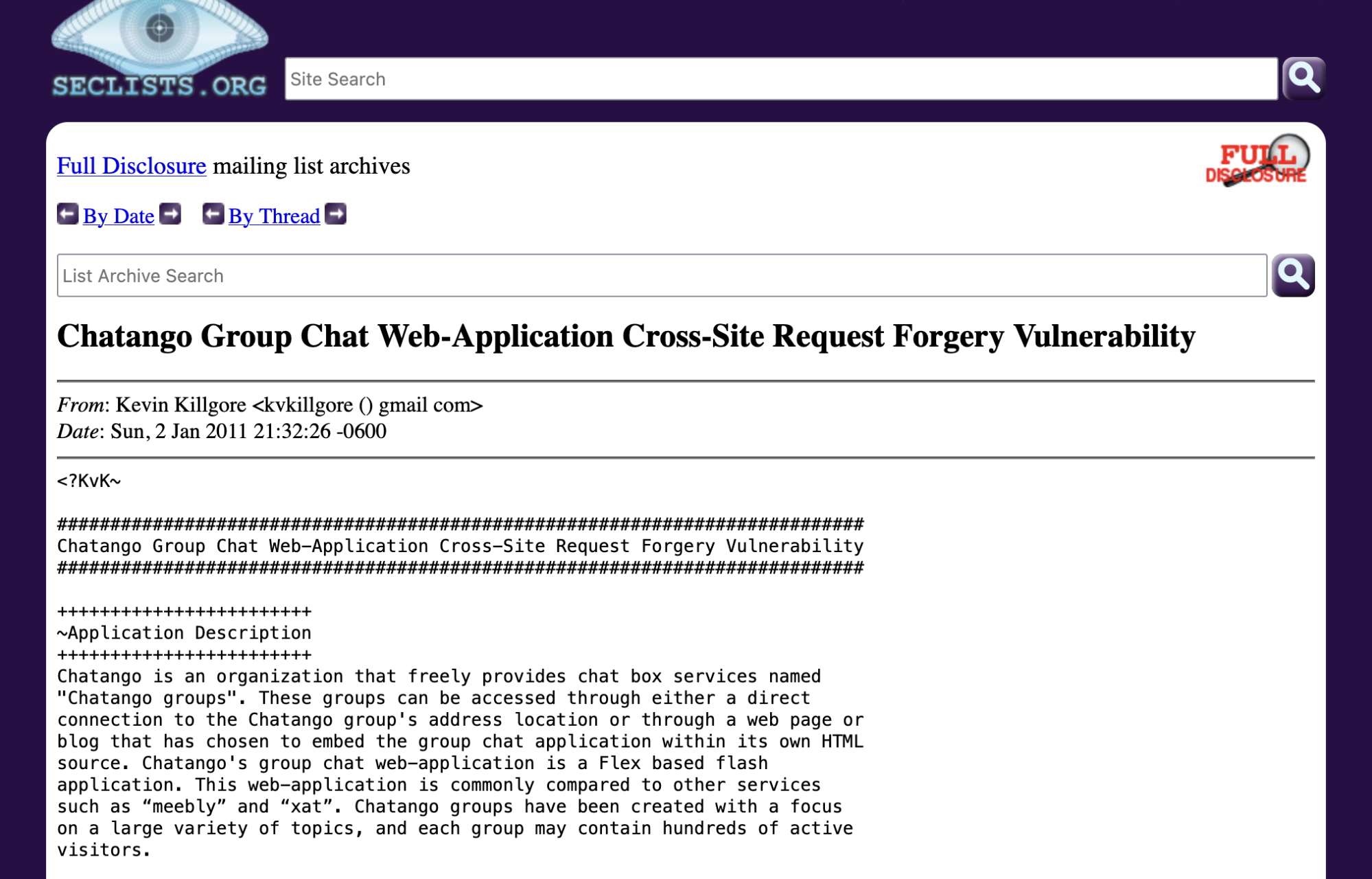
Chatango is one such service: an online chat platform that allows operators to embed live chatrooms directly into third-party websites, making them accessible to any visitor, regardless of whether they hold a Chatango account. While this functionality is ostensibly benign, a client-side Cross-Site Request Forgery (CSRF) vulnerability (first publicly disclosed in 2011 and since accepted by Chatango as a design decision) creates an interesting deanonymization vector. This vulnerability enables external actors, including law enforcement agencies, government bodies, and hacktivist groups, to passively harvest the IP addresses, user-agent strings, and associated metadata of anyone present in a chatroom, including passive visitors on sites where the chatroom is embedded.
Figure I - Full Disclosure of CSRF on chatango
Frankly, this finding isn't groundbreaking on its own. What made it worth writing about is the context: a significant number of sites related to piracy, adult content, and other privacy-sensitive use cases are actively embedding Chatango chatrooms, inadvertently exposing their users to de-anonymization. Whatever your feelings on piracy or adult fetish content, it is worth understanding the cause and effect of vulnerabilities which in theory, may seem benign, but in effect might enable something more insidious.
Figure II - Example of a Polish website using an embedded chatango feed
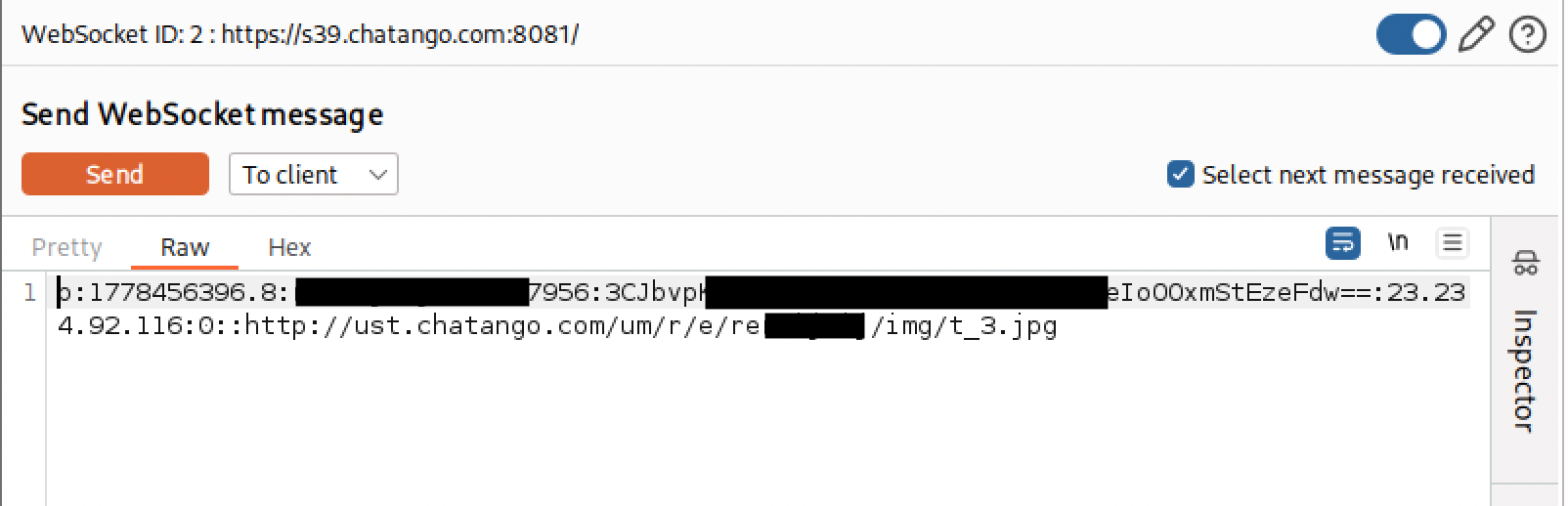
Under normal operating conditions, when a user shares an image within a Chatango chatroom, the photo file is stored and hosted on Chatango's own infrastructure and the request for that file remains within its ecosystem. However, the platform also accepts externally hosted image URLs, provided the link carries a recognized image file extension such as .jpg or .png. When such a URL is shared, each user's browser independently fetches and attempts to render the resource from that external location.
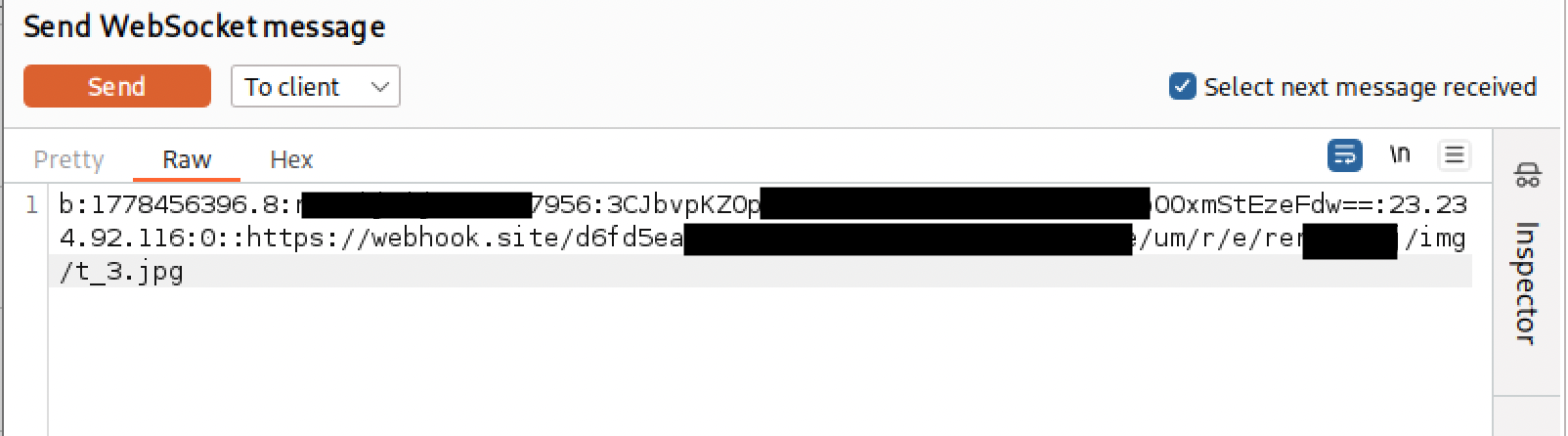
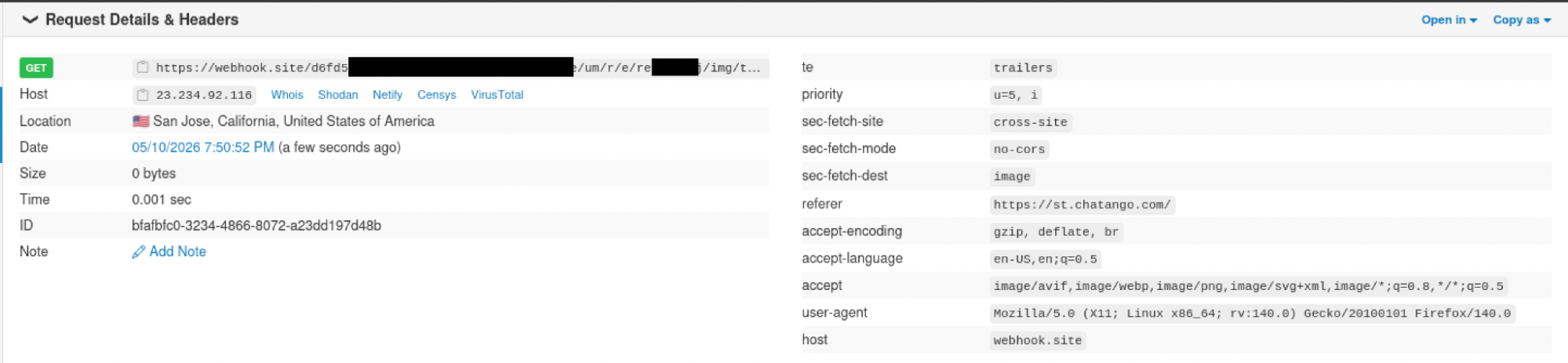
This behavior becomes a liability when the external resource is controlled by a malicious actor. By substituting a legitimate image URL with one pointing to an attacker-controlled server (in this example, a webhook is used) the actor can silently trigger outbound requests from every single client viewing the chatroom. Each of those requests exposes the user's IP address, user-agent string, and other request metadata, effectively providing the attacker with a real-time roster of everyone in the room.
Figure III - Websocket messages sent when a user shares an image
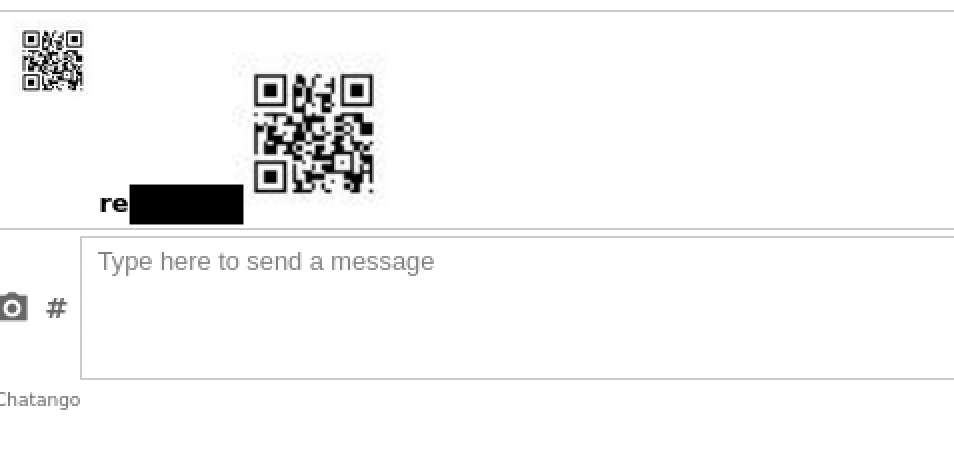
Once the URL is shared in the chat, the chatango platform understands that the URL is a photo resource and each user will independently load the and render the image (as seen below in figure IV).
Figure IV - Image of a QR code being rendered within the chat
Figure V - Modified websocket message with webhook.site URL
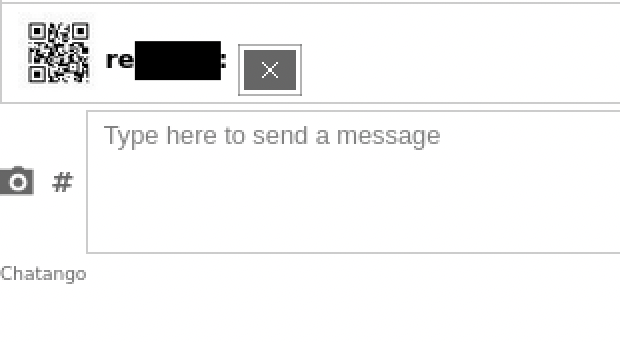
Figure VI - Image fails to load within chat
Critically, this exposure is not limited to active participants. Any visitor to a site with an embedded Chatango feed (even one who never creates an account or interacts with the chat) is equally susceptible. The chatroom loads passively alongside the page, and the malicious image request fires without any user action or awareness.
Figure VII - Captured request from a chat viewer
The consequences of this vulnerability are particularly interesting given the categories of sites actively embedding Chatango chatrooms. A substantial number of platforms associated with piracy, adult content, and other privacy-sensitive use cases have integrated the service, unknowingly exposing their user bases to passive surveillance.
Consider a concrete scenario: a user navigates to a site hosting pirated content. The site has a Chatango room embedded in the page. The user never opens the chat or sends a message and they do not even have a chatango account. A third party (whether a law enforcement agency, a copyright enforcement group, or a private investigator acting on behalf of a rights holder) need only transmit a single modified image URL into that chatroom. From that moment, they have silently collected the IP address and device fingerprint of every visitor on the page. That IP address can be subpoenaed from an Internet Service Provider, mapped to a physical address, and leveraged as the basis for civil litigation, financial penalties, or criminal referral. The user has no indication that anything has occurred.
IP-based identification has underpinned large-scale copyright enforcement actions for years. Passive, scalable collection mechanisms such as this one reduce the operational cost of that surveillance significantly, lowering the barrier for enforcement actors to cast a wide net with minimal effort.
For site operators, embedding any third-party service is an implicit extension of trust and liability. Before integrating any widget, chat service, or external feed, it is essential to audit the outbound requests that service can trigger from your users' browsers, and to assess whether those requests can be manipulated by parties outside your control. Threat modeling cannot be confined to your own codebase but must account for every dependency you introduce into your environment.
For end users, web traffic carries inherent exposure that is rarely visible or intuitive. Loading a page is not a passive act and loading a single webpage might create a waterfall of third-party requests, some of which may be directed to servers operated by parties whose interests are misaligned with your own. In a case like this, a Virtual Private Network (VPN) can ensure that the IP address disclosed in those requests belongs to the VPN provider, not to the user’s ISP, which can (depending on the VPN provider) protect the user’s home IP address from an investigation.
Know your exposure, understand your dependencies, and treat your IP address as the personally identifiable information that it is.
Stay safe out there.
This article is intended solely for educational and informational purposes, to promote awareness of cybersecurity risks and encourage responsible security practices among site operators and end users alike. The research presented in this article was conducted exclusively within controlled, isolated test environments using accounts and chatrooms created solely for the purpose of this analysis. No vulnerability identified in the course of this research was leveraged against any real user, platform, or third-party system. All findings were disclosed responsibly to Chatango prior to publication.
Any individual who chooses to replicate, reproduce, or build upon the techniques described herein does so entirely at their own risk and assumes full legal and ethical responsibility for their actions. The author expressly disclaims any and all liability arising from the misuse of the information presented in this article. This work is not an endorsement, instruction, or invitation to exploit any vulnerability, system, or service.
Builtwith Trends, trends.builtwith.com/websitelist/Chatango. Accessed 11 May 2026.
“Censys Search.” Censys, platform.censys.io/search?q=web.cert.names%3A+%22chatango.com%22+and+web.endpoints.http.status_code%3A+200. Accessed 10 May 2026.
Chatango - Crunchbase Company Profile & Funding, www.crunchbase.com/organization/chatango. Accessed 11 May 2026.
Killgore, Kevin. “Chatango Group CHAT Web-Application Cross-Site Request Forgery Vulnerability.” Full Disclosure: Chatango Group Chat Web-Application Cross-Site Request Forgery Vulnerability, seclists.org/fulldisclosure/2011/Jan/29. Accessed 11 May 2026.
“Najlepsze Tłumaczenia Yaoi W SIECI :D.” Dracaena, 5 Nov. 2026, dracaena.webd.pl/.